Friday, March 19, 2010

Mike


Today, I drove to Saginaw to see my ocularist and friend Mike Bain. I can't take my prosthesis in and out anymore, since I got the articulated peg, and it needed to be removed and cleaned and adjusted a little bit. In spite of the long drive, I always look forward to seeing Mike, who has painstakingly handcrafted two prosthetic eyes for me. He has done this with great skill and tremendous care and thoughtfulness, and I have written about Mike and my prosthesis several times on this blog.

I can't overstate the importance of my close and trusting relationship with Mike or the complexity of my relationship with him, and I am sure that this is the case with all of us who have lost a body part and had to have an artificial one made in its place. This artificial part has to function to some degree; it has to be modified, improved, fixed and changed as time and the rest of the body, the natural part, evolves; it has to look as natural as possible to the casual observer (though I now realize that no prostheses really fool anybody past a cursory glance no matter how good they are); and maybe most importantly, it has to in some way compensate for the lost part to the person who owns it. This last point may be the most important one and the one least understood by others: we have to be comfortable with this new piece of anatomy and getting it to that point has to be a real challenge for the prosthesis maker. They do something that no one else can: they help us feel whole again.

As always, we chat for awhile, sitting in one of the examining rooms that Mike operates out of at the eye clinic. We talk about work, and family, and tease each other about our political differences. We always laugh a lot, though I have cried, too, more than once. When he works on my eye, he is gentle and considerate. There is an intimacy between us, and a comfort level-the kind that comes from going through something horrible together that turns out to be ok. There is a sense that he got on the lifeboat with me as the Titanic of my old life broke in half and sank.

He always tells me I am beautiful, and I always believe him.


Tuesday, March 16, 2010

views of life-today's version.


Half my life ago, a sacred tiny being came through my body and left this world much sooner than anyone expected her to. I have written about the events that led up to Annie Lane's birth and death before on this blog-the last time was a year ago. Today, my heart is no less broken than any other March 16th, but the way I experience it continues to evolve. Right after her death, I remember thinking that it would probably not be possible for me to survive it. Ten years ago, I stopped crying at her grave and started talking to her a little while leaving some little token of flowers or driftwood. Five years ago I stopped talking and began learning to silently share that space and time with her, not really thinking about anything, not trying to pay tribute somehow or to conform to someone else's idea of the grieving mother. This year, I did not visit her place of rest, though it was a beautiful sunny day and it may have been a serene visit. Something is changing about the way I live with her in my heart, and it seems less important to me to go to that place, less important to mark the day with solemnity, grief, even remembrances. It has been 29 years. After living with her and without her for this long, she is just present, and there is no need to mark or commemorate the date.
I remember, two weeks after she died, walking into a store where there were baby clothes and nearly running back out the door, heart racing and breaking. Last week, a co-worker brought her newborn girl to our department dinner and we toasted and celebrated. I did not think of Annie Lane. I realize that I no longer live with the loss, but with the realization that this child, like my other two, was never mine, after all-no more than any of us belong to our parents or are really just the product of the two of them. We are so much more mysterious than that, so much more impossible to fathom. Like life itself.

Sunday, March 7, 2010

artist annie

These are some of Annie's latest paintings. I love them. To me, they are her best yet, at least the best I have seen. She goes to work every day, and then she comes home and paints. Other times, she draws in her sketchbook. When she is not drawing or painting, she is making things, or she is painting walls in her room beautiful colors. When she learned how to sew a few years back, she made beautiful dresses, combining fabrics in unexpected ways. When she gets dressed in the morning, it is another way that she composes art.
Annie began making art as soon as she could: drawing, painting, creating outfits for herself and dolls, arranging things on shelves, building, shaping, combining. There has never been a time in her life that this has not been the case. How happy I am that Annie has remained faithful to herself, through thick and thin, living her truth.

Sunday, February 28, 2010

The Farmhouse


Mark spotted it first, as we drove by on the way to look at another place. It was one of those beautiful old brick farmhouses, two-story, with a big front porch, decorative contrasting white brick trim and tall windows, arranged in threes and rounded at the top. There were several huge maple trees in the front yard. We instantly fell in love, and knew that this was the place to raise our children-Jon, 6, and Annie, 4. We spent the first night there in the living room in sleeping bags,with a cooler and a little tv. It felt a little like camping out. We wandered from room to room excitedly, wondering if we would ever be able to fill all of the rooms, accustomed as we were to our little rented ranch house. I will never forget how it felt to wake up there the next morning. From our bedroom window, we could see acres of blueberry bushes. I can still see their red branches against the snow in my mind. I have a wreath made of them hanging in my present home to remind me of them.
The house had a long history: a plaque set into the front wall announced the original owner's name and the date, 1884. We learned through relatives of this family that they had come from the Netherlands and built this house, raising seven children (two who died in childhood) and becoming the largest dairy farm in that area, bringing milk from house to house on a wagon, ladling it out to their customers into wooden buckets. One family member said that he remembered the day that the indoor plumbing was installed. Mark and I cherished all of these stories and felt lucky to be there, to extend the house's history as a new family. We worked hard, fixing it up. I rag-painted, stenciled, wallpapered, stained, scrubbed, sewed curtains and found antiques. Mark mowed, trimmed, weeded, repaired, shined up old brass hinges, fixed old doorknobs, rebuilt the old front porch. He built a treehouse and ladder for the kids. He made a sign for above the garage: OUR HOUSE IS A VERY, VERY, VERY FINE HOUSE, WITH TWO CATS IN THE YARD...." The kids settled into their own rooms and played in the yard and rode bikes and walked to the pond across the street and picked blueberries and rode bikes to Bill's Greenhouse and rode on the sled, pulled by Mark on the tractor, on the winter streets. They climbed the ladder to the tree house and huddled inside (until the ladder got stolen).
I remember still all of the places on the old wood floors that creaked, especially in the dining room, and I remember how the stairs sounded. The shelves in the closets and the kitchen cupboards were thick old wood. The kitchen counters were crafted of old wood. Mark refinished them and oiled them til they shone.
The glass in the windows had bubbles in it-old glass, made long ago. We are quite sure that there was a ghost upstairs-a woman, maybe watching over those sick children so long ago. We always scurried past that hallway, and it was years before we talked about it. The garage had old, old wood stored in it, and old bricks, and old glass bottles. There were the most beautiful lilac bushes in the backyard, and so many tall and stately evergreens in which the kids played and built forts. Annie climbed the tree by the garage and sat on the roof. Jon and his friend Joey played baseball. The basement had three rooms and was a scary, dark place that took some getting used to. I remember that musty smell.
One freezing February day, we started painting a mural on the grand old plaster wall that spanned the length of the back porch. We painted a picture of our house and the big maple tree in the front yard. The leaves of the tree are turning yellow and just beginning to fall. Our cat Fluffy is sitting on the branch. The beautiful old bricks are carefully painted, one by one. Our wonderful dog, Goldie, is watching over us all.
Somehow, it is that painting that looks the most true and real to me when I think about our life together there. There was this beautiful old place, and it somehow was waiting for us, and the grass was green and the trees were tall, and I know that our voices still ring in the walls like the mice that scurried there in the winter. I know that the love we shared there still warms those rooms, though we have been away for over a decade now. I close my eyes and I am right there, once again, always.

Friday kids

On Fridays, I have a class of eight kids who are in a special program for the autistically impaired. There are seven boys and one girl, and they range in age from six or seven up to eleven. I have known most of them for a few years now. They used to be "mainstreamed" with the general population, sitting close to their aides, and not particpating much. Now, I see them as a separate group: eight kids and three aides for 3o minutes, gathered around a big table.
My first few lesson plans failed miserably as I groped to understand what would work with this population. I realized pretty quickly that a lot of what I relied on with my other lessons was not going to fly with this bunch. For example, you can't read a book to autistic kids and then expect them to be inspired by it and create art that reflects that. You can't present material or themes, like a video about fish, and say, "Ok, now, let's all make some fish of our own!" Slowly I am learning that the kids are most engaged when they can spend some time playing with the materials and the media unimpeded by my directions, guidance (beyond the bare minimum) or expectations. The challenge is to let go, let go, let go, just like it always is.
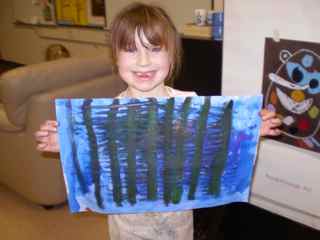
For example, an early success involved cutting long strips of black paper, and gluing it onto white paper. Cutting is a laborious process for some of these guys, some of whom have poor coordination and next to no hand strength. For others, it comes easier. Soem cut strip after strip and glued with varying amounts of white in between; others crowded the black strips together, overlapping the thick and thin, making textures and depth. They were beautiful, and I thought of Franz Kline. Earthenware clay is also a winner: one of my guys loves to slap and hit the clay, while another loves to flatten it and then feel the smooth contours created by his fingers; our lone girl loves to make birthday cakes, adding candle after candle; still another, who is a tiny, fragile little boy, pokes little mouse holes with his fingers and grins with obvious delight. During a recent painting session, one boy created the work above. I can tell you that the marks he painted were carefully executed. He worked carefully and with deliberation, choosing colors, placing his marks, choosing his brushstrokes. I think it is quite beautiful.
There is also a consistency of style and manner of exploration that seems to cut across media.
I am eager to recieve the next visual communication from them all.
It is not surprising that this class, of all of my thirty per week, is the one most likely to fill me with gratitude, with wonder, with joy, with great affection for this bunch of originals. I can hear them coming up the hall: hoots, giggles, shuffling of feet, a strange little barking shout. They show me, in their own way, who they are. They remind me that we all are just this different, just this unique, just this deserving of respect and acceptance as one of God's creatures on the earth.

Sunday, January 24, 2010

looking for life


I woke up this morning with this phrase going through my head. I am haunted by something Haitian msuician Wyclef Jean said when being interviewed about the earthquake: " Every night, we could hear the people singing. You can hear them chanting and still singing the words of God--it's unexplainable." This is what I remember from the hours of coverage, the telethon, the photographs in the paper, Anderson Cooper's nightly coverage: the Haitian people are singing every night. They don't sing because they are happy; they sing because they can.

Morgan Freeman read an excerpt from the poem below, written by New Orleans poet Kalamu ya Salaam. Listen to the beauty. Listen to the hope. We can see the life, through all of it.

Tomorrow's Toussaints

this is Haiti, a state
slaves snatched from surprised masters,
its high lands, home of this
world's sole successful
slave revolt. Haiti, where
freedom has flowered and flown
fascinating like long necked
flamingoes gracefully feeding
on snails in small pinkish
sunset colored sequestered ponds.
despite the meanness
and meagerness of life
eked out of eroding soil
and from exploited urban toil, there
is still so much beauty here in this
land where the sea sings roaring a shore
and fecund fertile hills lull and roll
quasi human in form
there is beauty here
in the unyielding way
our people,
colored charcoal, and
banana beige, and
shifting subtle shades
of ripe mango, or strongly
brown-black, sweet
as the such from
sun scorched staffs
of sugar cane,
have decided
we shall survive
we will live on
a peasant pauses
clear black eyes
searching far out over the horizon
the hoe motionless, suspended
in the midst
of all this shit and suffering
forced to bend low
still we stop and stand
and dream and believe
we shall be released
for what slaves
have done
slaves can do
and that begets
the beauty
slaves can do

Saturday, January 16, 2010

learning to teach art

I told the kids we could make some clay dragons this year, as part of the unit on Asian Art. The clay project for this unit has been tea cups, but the last time we made them, I felt uninspired and bored by the whole thing. They were just another kind of pinch pot, it seemed, despite my attempts to dress them up with rings on the bottom and kanji on the side. It dawned on me that we should make dragons, because there is no creature, imaginary or otherwise, that inspires a fifth grader more, and they are just magnificent beings--especially Chinese dragons, who are the antithesis of the ugly, stinky bad guy dragons who are a traditional part of so many Western epics. Anyway, I have never made a clay dragon and began to wrestle, in my mind, with how in the hell to teach such a thing. I worried about many things: dragons have a lot of parts, after all, and many of them are skinny and long and complicated and detailed. Not the kind of components that generally lend themselves to an elementary clay project. Things like that fall off and break. I worried about what to do first and how to lay out the steps and how to show them the way. I kicked myself for promising to do something that I really didn't know if I could pull off. I do this a lot and I do it to force myself to do it and to find a way to do it. As usual, the way presented itself and took me out of the role of Sage/Teacher and into the role of learner, where we all belong.
What happened was that I put some clay and tools on the tables and the kids set to work, in teams, to make a dragon and then to present it to the rest of the class. I modeled it loosely after the Quick Fire Challenges on Top Chef: a challenge, a time limit, and then, the presentation. It was great fun for all of us, and the results were astonishing to me. What is important to remember here is that I taught them nothing; my role was to provide the opportunity and perhaps some motivation. I got out of my own way, and out of their way, and watched them go.
The Zen teacher Shunryu Suzuki says that the best way to control people is to watch them: to give them a nice, big space and then just watch. This seems counterintuitive to us teachers, who instinctively want to run the show and control the environment through implementation of all kinds of behavior and management and teaching strategies. And they can be very effective, to be sure: I have found that I can make a group of children do just about anything. The rub is, of course, that these strategies generally suck all of the creativity, let alone the freedom and joy, out of the classroom and the learning lives of the kids. And, the teachers.
A colleague recently has implemented yet another behavior control system in which children's names are listed on the board and consequences doled out. I remember seeing something like that when I student taught and thinking, do I really want to teach? Is this what it is about?
My experience with the clay dragons is what good teaching has become for me. If I can watch it unfold with the creators, it is nothing but joy.

Thursday, December 31, 2009

dec 30 early morning


I am back at my father's house. We had sunshine the whole trip down. I sleep in his wife's bedroom. She is in Miami with her daughter; she does not have snow or cold winds or an old man to take care of. Her room is full of flowers-the draperies, the chair, the painted dresser, the sheets. Dried flowers arranged in a shadow frame-her daughter's business. Pictures of her grandchildren in different sized frames. She has been my dad's wife for thirty years. Our family pictures have never blended.
Last night I dreamed of my first husband. I washed my hair in the kitchen sink this morning, using green travel-sized shampoo and conditioner. I made organic coffee in the french press that I brought from home. Dad's coffeemaker is an old white drip-pot of an obscure brand, and he buys his coffee from Dollar General.
This is my third trip here in a month. The route is straight through Indiana, down route 41. There are old houses, weather-beaten barns, occasional farm animals and worn signs. We pass through several little towns. The skies are usually beautiful. I stop at Subway and get gas at the Pilot station. At my dad's corner, there is a machine rental place, and huge backhoes are lined up along the highway. They always look like brontosaurus heads to me, necks extended.
I read in Dad's chair until I hear sounds. First, the water in his bathroom. Then, the thumping of his scooting down the stairs, one step at a time, on his bottom. It has only been ten days since he fell down those stairs. There is still blood in the carpet; I make a note call the guy to finish the job. He comes around the corner and smiles. He is wearing his Christmas sweater. I want to cry but smile back.

Thursday, October 15, 2009

residue


what is the residue of the past six weeks or so? this is the question that floats through my head this morning...residue, like what you see in the bottom of the coffee cup from a good cup of french press that you maybe ground a little too much or let sit a little too long. Or the residue at the bottom of the water containers my students use when painting-deep syrups of purple and brown.
Birthday residue: two cards propped on the kitchen counter and a shipping box in the recycling bin. Residue of Annie's last visit: wrinkles her bedspread, a necklace from Chicago waiting to be worn. The residue of a busy schedule: shoes and bookbags piling up by the door, dust gathering in the studio, no posts on the blog, no pictures in the camera. Thin ice when you need to create in order to breathe. Thin ice for all of us.
Teaching is hard, and the hardest part for me is to do it from my truest heart. If I don't, I feel dried out, hardened, grey, as we all do when we are merely going through the motions of life and not entering in to the beautiful, complex murkiness of the moment. Of course, there are children who don't accept my invitation to walk down that path, and my sadness in the face of this is palpable. I try not to take it personally. There are others with whom I experience the kind of creative communion that fleshes out my heart and brings the color back to my cheeks. After all, what greater gift can we give one another than the sharing of the things that are truly alive for us-things with a heartbeat, things that warm us and say to us, "yes, that is it! exactly the right red! the right word!"
I am teaching four students this semester who are going to teach kids, and each Wednesday night, I pull some treasures out of my box and share them-tentatively, sometimes, because sharing my heart is so scary, but other times, with such a sense of urgency that I trip over myself. I want them to see the things that warm my heart. I want them to find what will warm theirs and to share with children their stories through their work. It is a holy gift.
The residue of last night's class is curled into the corner of my heart, still sleeping. When we got to our cars at the end, we saw the beauty of the leaf shadow on the car. A shadow we may not have seen had our hearts not been together, encouraging each other to look.

Friday, August 21, 2009

NOLA


i've had the urge to write for two weeks and haven't done it because I have been either working or staring at a TV or sleeping. Apparently, all of these things seem to be easier than writing, making art, doing yoga, meditating, going for a run...all things that I wish I could have listed as reasons why I have not updated my blog recently.
I want to tell you that going to New Orleans was a beautiful thing. Jon starts back at Tulane on Monday to finish Masters in architecture and together we searched for housing, lazily smoked in the shade, watched the sun go down at the fly, ate incredible food and tried to avoid moving too fast--just too hot for the type of frenetic movements characteristic of us Michiganders. We bought hats at Meyer the Hatter, the oldest habedashery in the South. We met some unforgettable people, including a guy named Johnny Angel, who was one of the people who had a room to rent. He was probably in his 40's somewhere, and had a huge, jet-black pompadour ala Elvis. His kitchen was fabulous, full of retro kitsch like Aunt Jemima images and cool old wallpaper. We went to the Columns Hotel and had drinks under huge tropical plants sitting on old wrought-iron furniture. We drove all over the city, up St. Charles, under the huge live oaks; up and down Tchoupitoulas, past four-star restaurants and galleries on one end and old, beat-up shotguns on the other. We walked, or rather hiked, up the old sidewalks, so uprooted by age, tree roots, (Katrina?), and diversity of materials that failure to pay heed could quickly result in a bad wipe-out.
Jon found a tiny little house in the back yard of a woman named Hannah, a woman with three kids who will need some help around the house and with babysitting that Jon can trade for a cut in rent. When we walked into the happy orange kitchen, we both knew that this would be the place. It is five minutes from the Tulane campus, the grocery and the gym. I left feeling that he was going to be ok.