Tuesday, May 11, 2010


nobody knows why the blues take hold of you, but I have them.
I can't seem to write anything that seems like the truth but doesn't seem like self-pity, so I am not writing anything. I am sitting in the fire these days, trying to stay conscious, staying with what comes. driving through the fog with the high beams on.
talking to my trusted spiritual guide today, who tells me something he heard:
the anecdote to exhaustion is not always rest. instead, it may be wholeheartedness.
somehow, the heart is not invested in life today. i will welcome the return of my passion. I look forward to the return of the energy that eludes me now; to feel that pulse again running through me. the trick here is not to reach for ways to jumpstart artificially-through substance abuse to deaden and distract, through falsely engaging in communication just to avoid being alone, through telling a story about myself or others today that provides a temporary answer for the why of it. To just stay with it as it comes, ride through, ignore thoughts, heed heart, seek no other remedy.
I have spent much of my life listening to everyone but myself, but at this moment I hear.
I hear the soothing, gut-wrenching, heartbreaking, beautiful sounds of the blues.

Sunday, April 18, 2010

st joe

My dad took a lot of pictures of us. An accomplished amateur photographer, he had a dark room down in the basement that I have written about before on this blog, and he often had camera in hand. I have boxes of slightly curled, shiny pictures of all different sizes that were produced in the Hayes Photolab, a name he stamped on the back of them before distributing to friends and family. There are hundreds of them. I remember putting them on the photo dryer, a large, two-sided contraption with flat surfaces upon which the wet photos were laid. Then, a canvas cover was pulled tightly over them. You rotated the machine and carefully removed the images when they dried. They always wound up curly on the edges. This was the work of the "dry man", as my dad called it, and was not as important as the work of the "wet man", which you had to graduate to: actually developing the prints in the chemicals and then throwing them on the "bath" was the part I loved most. I also loved running the finished prints upstairs to show my mother, who was usually in her chair, dog on lap, with a mystery novel of some sort. She would carefully put the bookmark in, close the book and look at each picture as I chattered about all that went into their creation. She must have looked at thousands of pictures during my childhood, and yet, if she was bored, she never showed it.
We are leaning against our '58 Ford station wagon that was two-toned, red and white. I named her Beauty Glamour on the day my dad drove her home and adored that car over all others we ever owned ( a considerable number, in that my dad was a confirmed car officianado and his best friend Lee was a Ford dealer). Beauty Glamour had red leather seats, and I liked to think that my dad picked that car out for me, because he used to say I was "especially made for red."

It might be early spring, like it is now, the sun warm and intoxicating on our faces, our little jackets, no doubt carefully picked out my our mother, buttoned against the still-cold winds that blow through Michigan at will. It is morning, because my braids are still neat and tidy, as my mother braided them, one and then the other, sitting on the bar stool, cigarette in ash tray, mug of coffee with cream, lipstick print on the edge in cherry red. My sister is carrying her Tiger and, as is so often the case, looks delighted to see my dad and his camera. My brother scrunches his face as if stifling a giggle. Maybe my dad said something silly or irreverant ("Say shit!") to get us to laugh. We are happy kids, well-loved, and it is spring in the sun.
Click.

Tuesday, March 23, 2010

Sunday, March 21, 2010

Frances

I've been writing a blogpost in my head about my mother lately. This morning, I found a poem by Mary Oliver (you may read it in the previous post) that I found true and beautiful, but I don't want to write about my relationship with my mother, or speculate about the mystery of who she was, or cry over her. Not today. I just want to see if I can create some kind of image of her that will feed my heart for the time being. In the world of the spirit, our relationships are just as complicated with those who have passed as with the living. Our ties with the dead continue to evolve and change and impact us with no need for traditional communication. And, I have found that as the years go by, it is far more difficult, or maybe just less necessary, to put into sentences our memories of them. I see my mother now in the things of the world that remind me of her. This is how people stay alive for us, I think-through the life of what remains.
I have some of her posessions: her collection of turquoise Indian jewelry from a long-ago trip to New Mexico; an Indian print skirt, the tiny waist of which has always been a silent reproach; some art books. In the next layer, I have my deep love for the work of certain artists and artisans; my ability to sew (though never quite as well as she did); my vegetarian stirfry recipes; my fine hair; my ambivalent relationship with my femininity, my vulnerability, my body, men.
Every day things bring me back to her: ordering a muffin and coffee never fails to conjure up images of the two of us in a booth at the little luncheonette at JP Penney's (we split the muffin). When I see a big, luxurious sedan, particularly in a pastel color, I smile thinking of her beloved powder-blue Buick Electra. My little dog sleeps on my lap, as hers did each evening. When I see a Vera scarf, a bright flowered pattern, a colorful dress or dangly earrings, I see her wearing them. When I wish I had been less afraid in my earlier life, less dependent on the affections and the approval of a man, less worried about the results and more interested in the adventure, I think of her, and I wonder how her life would have been, or mine, for that matter, if we had been born now instead of then.
It has been 32 years since my mother died. I had seen her at Christmas, and she seemed tired. I teased her about that: she didn't even want to go to the fabric store. She died two weeks later, and I got the news from my dad, over the phone, on a cold January night. My father told me that she begged not to go to the hospital-she hated hospitals. Her complicated medical issues necessitated far too frequent visits and she insisted that she would be fine. When it was apparent that she was failing, he wrapped her up in the tartan plaid flannel bathrobe I got him
for Christmas and rushed her to the emergency room. She was taken off life support the following day. She was 52.
She died before I realized that I needed her much more than she needed me; long before I realized what she could teach me. The lessons are still there for me to learn, but only if I find new ways to listen.

a poem


Flare
by Mary Oliver

1.

Welcome to the silly, comforting poem.

It is not the sunrise,
which is a red rinse,
which is flaring all over the eastern sky;

it is not the rain falling out of the purse of God;

it is not the blue helmet of the sky afterward,

or the trees, or the beetle burrowing into the earth;

it is not the mockingbird who, in his own cadence,
will go on sizzling and clapping
from the branches of the catalpa that are thick with blossoms,
that are billowing and shining,
that are shaking in the wind.

2.

You still recall, sometimes, the old barn on your
great-grandfather's farm, a place you visited once,
and went into, all alone, while the grownups sat and
talked in the house.
It was empty, or almost. Wisps of hay covered the floor,
and some wasps sang at the windows, and maybe there was
a strange fluttering bird high above, disturbed, hoo-ing
a little and staring down from a messy ledge with wild,
binocular eyes.
Mostly, though, it smelled of milk, and the patience of
animals; the give-offs of the body were still in the air,
a vague ammonia, not unpleasant.
Mostly, though, it was restful and secret, the roof high
up and arched, the boards unpainted and plain.
You could have stayed there forever, a small child in a corner,
on the last raft of hay, dazzled by so much space that seemed
empty, but wasn't.
Then--you still remember--you felt the rap of hunger--it was
noon--and you turned from that twilight dream and hurried back
to the house, where the table was set, where an uncle patted you
on the shoulder for welcome, and there was your place at the table.

3.

Nothing lasts.
There is a graveyard where everything I am talking about is,
now.

I stood there once, on the green grass, scattering flowers.

4.

Nothing is so delicate or so finely hinged as the wings
of the green moth
against the lantern
against its heat
against the beak of the crow
in the early morning.

Yet the moth has trim, and feistiness, and not a drop
of self-pity.

Not in this world.

5.

My mother
was the blue wisteria,
my mother
was the mossy stream out behind the house,
my mother, alas, alas,
did not always love her life,
heavier than iron it was
as she carried it in her arms, from room to room,
oh, unforgettable!

I bury her
in a box
in the earth
and turn away.
My father
was a demon of frustrated dreams,
was a breaker of trust,
was a poor, thin boy with bad luck.
He followed God, there being no one else
he could talk to;
he swaggered before God, there being no one else
who would listen.
Listen,
this was his life.
I bury it in the earth.
I sweep the closets.
I leave the house.

6.

I mention them now,
I will not mention them again.

It is not lack of love
nor lack of sorrow.
But the iron thing they carried, I will not carry.

I give them--one, two, three, four--the kiss of courtesy,
of sweet thanks,
of anger, of good luck in the deep earth.
May they sleep well. May they soften.

But I will not give them the kiss of complicity.
I will not give them the responsibility for my life.

7.

Did you know that the ant has a tongue
with which to gather in all that it can
of sweetness?

Did you know that?

8.

The poem is not the world.
It isn't even the first page of the world.

But the poem wants to flower, like a flower.
It knows that much.

It wants to open itself,
like the door of a little temple,
so that you might step inside and be cooled and refreshed,
and less yourself than part of everything.

9.

The voice of the child crying out of the mouth of the
grown woman
is a misery and a disappointment.
The voice of the child howling out of the tall, bearded,
muscular man
is a misery, and a terror.

10.

Therefore, tell me:
what will engage you?
What will open the dark fields of your mind,
like a lover
at first touching?

11.

Anyway,
there was no barn.
No child in the barn.

No uncle no table no kitchen.

Only a long lovely field full of bobolinks.

12.

When loneliness comes stalking, go into the fields, consider
the orderliness of the world. Notice
something you have never noticed before,

like the tambourine sound of the snow-cricket
whose pale green body is no longer than your thumb.

Stare hard at the hummingbird, in the summer rain,
shaking the water-sparks from its wings.

Let grief be your sister, she will whether or no.
Rise up from the stump of sorrow, and be green also,
like the diligent leaves.

A lifetime isn't long enough for the beauty of this world
and the responsibilities of your life.

Scatter your flowers over the graves, and walk away.
Be good-natured and untidy in your exuberance.

In the glare of your mind, be modest.
And beholden to what is tactile, and thrilling.

Live with the beetle, and the wind.

This is the dark bread of the poem.
This is the dark and nourishing bread of the poem.

Friday, March 19, 2010

Mike


Today, I drove to Saginaw to see my ocularist and friend Mike Bain. I can't take my prosthesis in and out anymore, since I got the articulated peg, and it needed to be removed and cleaned and adjusted a little bit. In spite of the long drive, I always look forward to seeing Mike, who has painstakingly handcrafted two prosthetic eyes for me. He has done this with great skill and tremendous care and thoughtfulness, and I have written about Mike and my prosthesis several times on this blog.

I can't overstate the importance of my close and trusting relationship with Mike or the complexity of my relationship with him, and I am sure that this is the case with all of us who have lost a body part and had to have an artificial one made in its place. This artificial part has to function to some degree; it has to be modified, improved, fixed and changed as time and the rest of the body, the natural part, evolves; it has to look as natural as possible to the casual observer (though I now realize that no prostheses really fool anybody past a cursory glance no matter how good they are); and maybe most importantly, it has to in some way compensate for the lost part to the person who owns it. This last point may be the most important one and the one least understood by others: we have to be comfortable with this new piece of anatomy and getting it to that point has to be a real challenge for the prosthesis maker. They do something that no one else can: they help us feel whole again.

As always, we chat for awhile, sitting in one of the examining rooms that Mike operates out of at the eye clinic. We talk about work, and family, and tease each other about our political differences. We always laugh a lot, though I have cried, too, more than once. When he works on my eye, he is gentle and considerate. There is an intimacy between us, and a comfort level-the kind that comes from going through something horrible together that turns out to be ok. There is a sense that he got on the lifeboat with me as the Titanic of my old life broke in half and sank.

He always tells me I am beautiful, and I always believe him.


Tuesday, March 16, 2010

views of life-today's version.


Half my life ago, a sacred tiny being came through my body and left this world much sooner than anyone expected her to. I have written about the events that led up to Annie Lane's birth and death before on this blog-the last time was a year ago. Today, my heart is no less broken than any other March 16th, but the way I experience it continues to evolve. Right after her death, I remember thinking that it would probably not be possible for me to survive it. Ten years ago, I stopped crying at her grave and started talking to her a little while leaving some little token of flowers or driftwood. Five years ago I stopped talking and began learning to silently share that space and time with her, not really thinking about anything, not trying to pay tribute somehow or to conform to someone else's idea of the grieving mother. This year, I did not visit her place of rest, though it was a beautiful sunny day and it may have been a serene visit. Something is changing about the way I live with her in my heart, and it seems less important to me to go to that place, less important to mark the day with solemnity, grief, even remembrances. It has been 29 years. After living with her and without her for this long, she is just present, and there is no need to mark or commemorate the date.
I remember, two weeks after she died, walking into a store where there were baby clothes and nearly running back out the door, heart racing and breaking. Last week, a co-worker brought her newborn girl to our department dinner and we toasted and celebrated. I did not think of Annie Lane. I realize that I no longer live with the loss, but with the realization that this child, like my other two, was never mine, after all-no more than any of us belong to our parents or are really just the product of the two of them. We are so much more mysterious than that, so much more impossible to fathom. Like life itself.

Sunday, March 7, 2010

artist annie

These are some of Annie's latest paintings. I love them. To me, they are her best yet, at least the best I have seen. She goes to work every day, and then she comes home and paints. Other times, she draws in her sketchbook. When she is not drawing or painting, she is making things, or she is painting walls in her room beautiful colors. When she learned how to sew a few years back, she made beautiful dresses, combining fabrics in unexpected ways. When she gets dressed in the morning, it is another way that she composes art.
Annie began making art as soon as she could: drawing, painting, creating outfits for herself and dolls, arranging things on shelves, building, shaping, combining. There has never been a time in her life that this has not been the case. How happy I am that Annie has remained faithful to herself, through thick and thin, living her truth.

Sunday, February 28, 2010

The Farmhouse


Mark spotted it first, as we drove by on the way to look at another place. It was one of those beautiful old brick farmhouses, two-story, with a big front porch, decorative contrasting white brick trim and tall windows, arranged in threes and rounded at the top. There were several huge maple trees in the front yard. We instantly fell in love, and knew that this was the place to raise our children-Jon, 6, and Annie, 4. We spent the first night there in the living room in sleeping bags,with a cooler and a little tv. It felt a little like camping out. We wandered from room to room excitedly, wondering if we would ever be able to fill all of the rooms, accustomed as we were to our little rented ranch house. I will never forget how it felt to wake up there the next morning. From our bedroom window, we could see acres of blueberry bushes. I can still see their red branches against the snow in my mind. I have a wreath made of them hanging in my present home to remind me of them.
The house had a long history: a plaque set into the front wall announced the original owner's name and the date, 1884. We learned through relatives of this family that they had come from the Netherlands and built this house, raising seven children (two who died in childhood) and becoming the largest dairy farm in that area, bringing milk from house to house on a wagon, ladling it out to their customers into wooden buckets. One family member said that he remembered the day that the indoor plumbing was installed. Mark and I cherished all of these stories and felt lucky to be there, to extend the house's history as a new family. We worked hard, fixing it up. I rag-painted, stenciled, wallpapered, stained, scrubbed, sewed curtains and found antiques. Mark mowed, trimmed, weeded, repaired, shined up old brass hinges, fixed old doorknobs, rebuilt the old front porch. He built a treehouse and ladder for the kids. He made a sign for above the garage: OUR HOUSE IS A VERY, VERY, VERY FINE HOUSE, WITH TWO CATS IN THE YARD...." The kids settled into their own rooms and played in the yard and rode bikes and walked to the pond across the street and picked blueberries and rode bikes to Bill's Greenhouse and rode on the sled, pulled by Mark on the tractor, on the winter streets. They climbed the ladder to the tree house and huddled inside (until the ladder got stolen).
I remember still all of the places on the old wood floors that creaked, especially in the dining room, and I remember how the stairs sounded. The shelves in the closets and the kitchen cupboards were thick old wood. The kitchen counters were crafted of old wood. Mark refinished them and oiled them til they shone.
The glass in the windows had bubbles in it-old glass, made long ago. We are quite sure that there was a ghost upstairs-a woman, maybe watching over those sick children so long ago. We always scurried past that hallway, and it was years before we talked about it. The garage had old, old wood stored in it, and old bricks, and old glass bottles. There were the most beautiful lilac bushes in the backyard, and so many tall and stately evergreens in which the kids played and built forts. Annie climbed the tree by the garage and sat on the roof. Jon and his friend Joey played baseball. The basement had three rooms and was a scary, dark place that took some getting used to. I remember that musty smell.
One freezing February day, we started painting a mural on the grand old plaster wall that spanned the length of the back porch. We painted a picture of our house and the big maple tree in the front yard. The leaves of the tree are turning yellow and just beginning to fall. Our cat Fluffy is sitting on the branch. The beautiful old bricks are carefully painted, one by one. Our wonderful dog, Goldie, is watching over us all.
Somehow, it is that painting that looks the most true and real to me when I think about our life together there. There was this beautiful old place, and it somehow was waiting for us, and the grass was green and the trees were tall, and I know that our voices still ring in the walls like the mice that scurried there in the winter. I know that the love we shared there still warms those rooms, though we have been away for over a decade now. I close my eyes and I am right there, once again, always.

Friday kids

On Fridays, I have a class of eight kids who are in a special program for the autistically impaired. There are seven boys and one girl, and they range in age from six or seven up to eleven. I have known most of them for a few years now. They used to be "mainstreamed" with the general population, sitting close to their aides, and not particpating much. Now, I see them as a separate group: eight kids and three aides for 3o minutes, gathered around a big table.
My first few lesson plans failed miserably as I groped to understand what would work with this population. I realized pretty quickly that a lot of what I relied on with my other lessons was not going to fly with this bunch. For example, you can't read a book to autistic kids and then expect them to be inspired by it and create art that reflects that. You can't present material or themes, like a video about fish, and say, "Ok, now, let's all make some fish of our own!" Slowly I am learning that the kids are most engaged when they can spend some time playing with the materials and the media unimpeded by my directions, guidance (beyond the bare minimum) or expectations. The challenge is to let go, let go, let go, just like it always is.
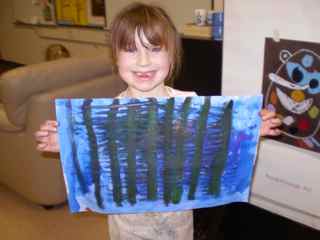
For example, an early success involved cutting long strips of black paper, and gluing it onto white paper. Cutting is a laborious process for some of these guys, some of whom have poor coordination and next to no hand strength. For others, it comes easier. Soem cut strip after strip and glued with varying amounts of white in between; others crowded the black strips together, overlapping the thick and thin, making textures and depth. They were beautiful, and I thought of Franz Kline. Earthenware clay is also a winner: one of my guys loves to slap and hit the clay, while another loves to flatten it and then feel the smooth contours created by his fingers; our lone girl loves to make birthday cakes, adding candle after candle; still another, who is a tiny, fragile little boy, pokes little mouse holes with his fingers and grins with obvious delight. During a recent painting session, one boy created the work above. I can tell you that the marks he painted were carefully executed. He worked carefully and with deliberation, choosing colors, placing his marks, choosing his brushstrokes. I think it is quite beautiful.
There is also a consistency of style and manner of exploration that seems to cut across media.
I am eager to recieve the next visual communication from them all.
It is not surprising that this class, of all of my thirty per week, is the one most likely to fill me with gratitude, with wonder, with joy, with great affection for this bunch of originals. I can hear them coming up the hall: hoots, giggles, shuffling of feet, a strange little barking shout. They show me, in their own way, who they are. They remind me that we all are just this different, just this unique, just this deserving of respect and acceptance as one of God's creatures on the earth.