Sunday, February 28, 2010

Friday kids

On Fridays, I have a class of eight kids who are in a special program for the autistically impaired. There are seven boys and one girl, and they range in age from six or seven up to eleven. I have known most of them for a few years now. They used to be "mainstreamed" with the general population, sitting close to their aides, and not particpating much. Now, I see them as a separate group: eight kids and three aides for 3o minutes, gathered around a big table.
My first few lesson plans failed miserably as I groped to understand what would work with this population. I realized pretty quickly that a lot of what I relied on with my other lessons was not going to fly with this bunch. For example, you can't read a book to autistic kids and then expect them to be inspired by it and create art that reflects that. You can't present material or themes, like a video about fish, and say, "Ok, now, let's all make some fish of our own!" Slowly I am learning that the kids are most engaged when they can spend some time playing with the materials and the media unimpeded by my directions, guidance (beyond the bare minimum) or expectations. The challenge is to let go, let go, let go, just like it always is.
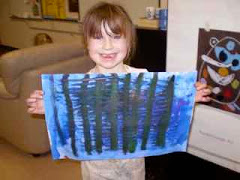
For example, an early success involved cutting long strips of black paper, and gluing it onto white paper. Cutting is a laborious process for some of these guys, some of whom have poor coordination and next to no hand strength. For others, it comes easier. Soem cut strip after strip and glued with varying amounts of white in between; others crowded the black strips together, overlapping the thick and thin, making textures and depth. They were beautiful, and I thought of Franz Kline. Earthenware clay is also a winner: one of my guys loves to slap and hit the clay, while another loves to flatten it and then feel the smooth contours created by his fingers; our lone girl loves to make birthday cakes, adding candle after candle; still another, who is a tiny, fragile little boy, pokes little mouse holes with his fingers and grins with obvious delight. During a recent painting session, one boy created the work above. I can tell you that the marks he painted were carefully executed. He worked carefully and with deliberation, choosing colors, placing his marks, choosing his brushstrokes. I think it is quite beautiful.
There is also a consistency of style and manner of exploration that seems to cut across media.
I am eager to recieve the next visual communication from them all.
It is not surprising that this class, of all of my thirty per week, is the one most likely to fill me with gratitude, with wonder, with joy, with great affection for this bunch of originals. I can hear them coming up the hall: hoots, giggles, shuffling of feet, a strange little barking shout. They show me, in their own way, who they are. They remind me that we all are just this different, just this unique, just this deserving of respect and acceptance as one of God's creatures on the earth.

Sunday, January 24, 2010

looking for life


I woke up this morning with this phrase going through my head. I am haunted by something Haitian msuician Wyclef Jean said when being interviewed about the earthquake: " Every night, we could hear the people singing. You can hear them chanting and still singing the words of God--it's unexplainable." This is what I remember from the hours of coverage, the telethon, the photographs in the paper, Anderson Cooper's nightly coverage: the Haitian people are singing every night. They don't sing because they are happy; they sing because they can.

Morgan Freeman read an excerpt from the poem below, written by New Orleans poet Kalamu ya Salaam. Listen to the beauty. Listen to the hope. We can see the life, through all of it.

Tomorrow's Toussaints

this is Haiti, a state
slaves snatched from surprised masters,
its high lands, home of this
world's sole successful
slave revolt. Haiti, where
freedom has flowered and flown
fascinating like long necked
flamingoes gracefully feeding
on snails in small pinkish
sunset colored sequestered ponds.
despite the meanness
and meagerness of life
eked out of eroding soil
and from exploited urban toil, there
is still so much beauty here in this
land where the sea sings roaring a shore
and fecund fertile hills lull and roll
quasi human in form
there is beauty here
in the unyielding way
our people,
colored charcoal, and
banana beige, and
shifting subtle shades
of ripe mango, or strongly
brown-black, sweet
as the such from
sun scorched staffs
of sugar cane,
have decided
we shall survive
we will live on
a peasant pauses
clear black eyes
searching far out over the horizon
the hoe motionless, suspended
in the midst
of all this shit and suffering
forced to bend low
still we stop and stand
and dream and believe
we shall be released
for what slaves
have done
slaves can do
and that begets
the beauty
slaves can do

Saturday, January 16, 2010

learning to teach art

I told the kids we could make some clay dragons this year, as part of the unit on Asian Art. The clay project for this unit has been tea cups, but the last time we made them, I felt uninspired and bored by the whole thing. They were just another kind of pinch pot, it seemed, despite my attempts to dress them up with rings on the bottom and kanji on the side. It dawned on me that we should make dragons, because there is no creature, imaginary or otherwise, that inspires a fifth grader more, and they are just magnificent beings--especially Chinese dragons, who are the antithesis of the ugly, stinky bad guy dragons who are a traditional part of so many Western epics. Anyway, I have never made a clay dragon and began to wrestle, in my mind, with how in the hell to teach such a thing. I worried about many things: dragons have a lot of parts, after all, and many of them are skinny and long and complicated and detailed. Not the kind of components that generally lend themselves to an elementary clay project. Things like that fall off and break. I worried about what to do first and how to lay out the steps and how to show them the way. I kicked myself for promising to do something that I really didn't know if I could pull off. I do this a lot and I do it to force myself to do it and to find a way to do it. As usual, the way presented itself and took me out of the role of Sage/Teacher and into the role of learner, where we all belong.
What happened was that I put some clay and tools on the tables and the kids set to work, in teams, to make a dragon and then to present it to the rest of the class. I modeled it loosely after the Quick Fire Challenges on Top Chef: a challenge, a time limit, and then, the presentation. It was great fun for all of us, and the results were astonishing to me. What is important to remember here is that I taught them nothing; my role was to provide the opportunity and perhaps some motivation. I got out of my own way, and out of their way, and watched them go.
The Zen teacher Shunryu Suzuki says that the best way to control people is to watch them: to give them a nice, big space and then just watch. This seems counterintuitive to us teachers, who instinctively want to run the show and control the environment through implementation of all kinds of behavior and management and teaching strategies. And they can be very effective, to be sure: I have found that I can make a group of children do just about anything. The rub is, of course, that these strategies generally suck all of the creativity, let alone the freedom and joy, out of the classroom and the learning lives of the kids. And, the teachers.
A colleague recently has implemented yet another behavior control system in which children's names are listed on the board and consequences doled out. I remember seeing something like that when I student taught and thinking, do I really want to teach? Is this what it is about?
My experience with the clay dragons is what good teaching has become for me. If I can watch it unfold with the creators, it is nothing but joy.

Thursday, December 31, 2009

dec 30 early morning


I am back at my father's house. We had sunshine the whole trip down. I sleep in his wife's bedroom. She is in Miami with her daughter; she does not have snow or cold winds or an old man to take care of. Her room is full of flowers-the draperies, the chair, the painted dresser, the sheets. Dried flowers arranged in a shadow frame-her daughter's business. Pictures of her grandchildren in different sized frames. She has been my dad's wife for thirty years. Our family pictures have never blended.
Last night I dreamed of my first husband. I washed my hair in the kitchen sink this morning, using green travel-sized shampoo and conditioner. I made organic coffee in the french press that I brought from home. Dad's coffeemaker is an old white drip-pot of an obscure brand, and he buys his coffee from Dollar General.
This is my third trip here in a month. The route is straight through Indiana, down route 41. There are old houses, weather-beaten barns, occasional farm animals and worn signs. We pass through several little towns. The skies are usually beautiful. I stop at Subway and get gas at the Pilot station. At my dad's corner, there is a machine rental place, and huge backhoes are lined up along the highway. They always look like brontosaurus heads to me, necks extended.
I read in Dad's chair until I hear sounds. First, the water in his bathroom. Then, the thumping of his scooting down the stairs, one step at a time, on his bottom. It has only been ten days since he fell down those stairs. There is still blood in the carpet; I make a note call the guy to finish the job. He comes around the corner and smiles. He is wearing his Christmas sweater. I want to cry but smile back.

Thursday, October 15, 2009

residue


what is the residue of the past six weeks or so? this is the question that floats through my head this morning...residue, like what you see in the bottom of the coffee cup from a good cup of french press that you maybe ground a little too much or let sit a little too long. Or the residue at the bottom of the water containers my students use when painting-deep syrups of purple and brown.
Birthday residue: two cards propped on the kitchen counter and a shipping box in the recycling bin. Residue of Annie's last visit: wrinkles her bedspread, a necklace from Chicago waiting to be worn. The residue of a busy schedule: shoes and bookbags piling up by the door, dust gathering in the studio, no posts on the blog, no pictures in the camera. Thin ice when you need to create in order to breathe. Thin ice for all of us.
Teaching is hard, and the hardest part for me is to do it from my truest heart. If I don't, I feel dried out, hardened, grey, as we all do when we are merely going through the motions of life and not entering in to the beautiful, complex murkiness of the moment. Of course, there are children who don't accept my invitation to walk down that path, and my sadness in the face of this is palpable. I try not to take it personally. There are others with whom I experience the kind of creative communion that fleshes out my heart and brings the color back to my cheeks. After all, what greater gift can we give one another than the sharing of the things that are truly alive for us-things with a heartbeat, things that warm us and say to us, "yes, that is it! exactly the right red! the right word!"
I am teaching four students this semester who are going to teach kids, and each Wednesday night, I pull some treasures out of my box and share them-tentatively, sometimes, because sharing my heart is so scary, but other times, with such a sense of urgency that I trip over myself. I want them to see the things that warm my heart. I want them to find what will warm theirs and to share with children their stories through their work. It is a holy gift.
The residue of last night's class is curled into the corner of my heart, still sleeping. When we got to our cars at the end, we saw the beauty of the leaf shadow on the car. A shadow we may not have seen had our hearts not been together, encouraging each other to look.

Friday, August 21, 2009

NOLA


i've had the urge to write for two weeks and haven't done it because I have been either working or staring at a TV or sleeping. Apparently, all of these things seem to be easier than writing, making art, doing yoga, meditating, going for a run...all things that I wish I could have listed as reasons why I have not updated my blog recently.
I want to tell you that going to New Orleans was a beautiful thing. Jon starts back at Tulane on Monday to finish Masters in architecture and together we searched for housing, lazily smoked in the shade, watched the sun go down at the fly, ate incredible food and tried to avoid moving too fast--just too hot for the type of frenetic movements characteristic of us Michiganders. We bought hats at Meyer the Hatter, the oldest habedashery in the South. We met some unforgettable people, including a guy named Johnny Angel, who was one of the people who had a room to rent. He was probably in his 40's somewhere, and had a huge, jet-black pompadour ala Elvis. His kitchen was fabulous, full of retro kitsch like Aunt Jemima images and cool old wallpaper. We went to the Columns Hotel and had drinks under huge tropical plants sitting on old wrought-iron furniture. We drove all over the city, up St. Charles, under the huge live oaks; up and down Tchoupitoulas, past four-star restaurants and galleries on one end and old, beat-up shotguns on the other. We walked, or rather hiked, up the old sidewalks, so uprooted by age, tree roots, (Katrina?), and diversity of materials that failure to pay heed could quickly result in a bad wipe-out.
Jon found a tiny little house in the back yard of a woman named Hannah, a woman with three kids who will need some help around the house and with babysitting that Jon can trade for a cut in rent. When we walked into the happy orange kitchen, we both knew that this would be the place. It is five minutes from the Tulane campus, the grocery and the gym. I left feeling that he was going to be ok.


Wednesday, July 15, 2009

Taos, New Mexico


Taos energy is like no other I have experienced. It is a town mostly composed of artists, spiritual seekers, odd ducks and visionaries. the red adobe walls glow in the late sun and provide a perfect backdrop for the many mountain flowers that grow everywhere. Here, you see purple sage; there, a collection of red pots; up the road, an old gate that has creeked back and forth for generations.
Today I am helping my friend Ginto Naujokas, a Taos potter, load an outdoor, woodfire kiln. I am documenting all of this for my students. I have told Ginto that his face will grace a bulletin board this fall: "GINTO THE POTTER."
There is so much I have to tell you and I am busily writing notes and taking pictures. It is hard to properly express beauty and life like this. Until then, have a beautiful day wherever your life is taking you.
love,
claudia

Tuesday, July 7, 2009

"wild geese" by mary oliver


took off on a road trip this morning, and will be checking in with you via this blog along the way. this poem by mary oliver captures so much for me tonight:


Wild Geese

You do not have to be good.
You do not have to walk on your knees
for a hundred miles through the desert, repenting.
You only have to let the soft animal of your body
love what it loves.
Tell me about despair, yours, and I will tell you mine.
Meanwhile the world goes on.
Meanwhile the sun and the clear pebbles of the rain
are moving across the landscapes,
over the prairies and the deep trees,
the mountains and the rivers.
Meanwhile the wild geese, high in the clean blue air,
are heading home again.
Whoever you are, no matter how lonely,
the world offers itself to your imagination,
calls to you like the wild geese, harsh and exciting--
over and over announcing your place
in the family of things.

© Mary Oliver.

Saturday, July 4, 2009

sacred spaces


I just got back from a long visit with my dad. This picture was taken in New Harmony, before he, Deborah and I went out to dinner and a play there. We stopped at this memorial garden and wandered around first, admiring the way the tree branches seemed to join together to form a rooftop over this quiet, sacred space. It was hotter than hell, as it had been all week, in the 90's, but it felt comfortable here, and it was a feast for the senses. A fountain gave us the gift of the sound of softly falling water; the hostas burst forth lusciously; little benches with feminine curves invited us to sit.
I turned around, camera in hand, and saw my dad standing there, with is arms crossed, standing straight and tall and handsome, and took this picture. In it, I see his essence shining through. I thought, this is him, the eternal him. I see the same man I looked up at when dancing with him, my feet on his, when I was little. The invincible one. The next day I photographed many views of his basement, where he has multiple working spaces where he works on his trains and practices his trumpet. Again, I was struck by it: there he was, the same man. It could be that the spaces in which we do the work we were intended to do, the work that makes our hearts sing with gratitude, show at least as much about us as our faces do, especially when we get older, and we weat time as well as passion on them.

things i don't remember


o I don’t remember most of my kindergarten through fourth grade years. I am particularly blank on kinder and first grades beyond a few brief flashes of images…. kinder rugs and naptime and saying something stupid to the teacher and having her look at me with one of those disgusted looks I dreaded. First grade, cleaning out the fishbowl-come to think of it, why the hell did they make that a job for a first grader? -And dumping the damned fish down the drain in the process. I have no idea who my first grade teacher was. I have no idea who my second grade teacher was. I also don’t remember what the classrooms looked like. I remember the hallway because I was there for six years. I also remember the playground.

o I don’t’ remember what my first three houses looked like. The first one is understandable; after all, I was barely past infancy when we left it. But Forrest Avenue=the stairway, the front porch, the rhubarb plants in the back yard, the alley.
o Lewis Avenue-long curtains that were shiny and I thought quite ugly. The bedrooms are a blank. I probably shared them both with my little sister but I don’t remember.

o I don’t remember what my mother smelled like, or what her voice sounded like. The home movies I have of her do not have sound. Her voice is on a demo record for Kego the Eskimo, a story my dad was trying to sell that included a song. My mom played the voice of Mrs. Santa. I haven’t heard it since the kids were little and we played it for them during a visit to Grampy’s house.

o I don’t remember what I saw in Dave Treul. I remember a great deal about what happened during the two –plus years that we were together-places gone, events attended, snippets from particularly hideous fights, but not what I actually saw in him. I don’t’ remember actually loving him.

o I don’t remember most of the days between listing the farmhouse and actually moving out of it and I certainly and maybe thankfully don’t remember moving day. I am sure that it was hell, but mercifully, I don’t have much in my file on that one.

o I don’t remember what Annie Lane looked like, except that I remember thinking that she looked a lot like Jon, which was a relief, because someone at the hospital, I don’t remember who, told me that she heard that there was a facial deformity. I am glad that I saw for myself that it was not true. I wish I had a picture of my tiny daughter who never drew breath in this world.

o I don’t remember how bad it felt when I was at my worst, those many dark days and nights when demons flew through my head and I was unable to find solace, to rest, to feel safely held.

o I don’t remember being drunk feels like, or being stoned-but especially drunk. I haven’t had an experience that mimics drunkenness that would even be reminiscent, a time when I could say, “ wow, I feel drunk.” I have twice had anesthesia during my seventeen years of sobriety, and both times, I was just OUT, that fast. When I was on heavy pain meds after the enucleation surgery, I just felt sleepy.

o I don’t remember what hamburgers taste like, or chicken or steak, or bacon—you get the idea. I haven’t eaten meat for almost as long as I haven’t had a drink. I don’t miss meat. I don’t like the smell of it. I imagine the molecules traveling through the air, microscopic meat specks, and I don’t want them to get in my nose.

o I don’t remember what PMS feels like. How great is that.

o I don’t remember what is in all of those boxes down under the basement stairs and taking up space on the shelf in the garage. I filled them up before I moved here and I don’t know what I put in them. I have considered just having them all hauled away without opening them.

o I don’t remember what it is like to live without cell phones, cable TV, and computers. In fact, it is fascinating to me to sit and think about that. Hell, I hardly remember what it was like to be chained to a phone or computer by chords.everything is wireless now, and I talk on the phone in the car and pay my bills laying in bed with my laptop propped on my knees.

o I don’t remember to take my vitamins and other pills on a regular basis.

o I don’t remember how to do most math calculations. It has been too long and, as I suspected, I never did have to use any of them in real life, as my lying teachers contended.